Human-AI Collaborative Settings
.png)


Artificial Intelligence (AI) and Machine Learning (ML) are two powerful technologies which are developing at an exponential rate whilst simultaneously impacting our lives, in this short article we will aim to identify and review a few particular industry sectors which have been meaningfully impacted by the rise of AI.
Let’s begin with a bit of context, Artificial Intelligence, which is largely referred to as ‘AI’, is a sequence of algorithms which provide a machine the capacity to ‘think’ with little to no human intervention at all. A more detailed way to describe this would be to draw a connection between what we know as intelligence, and a system’s ability to adapt and improvise in a new environment. This also includes the ability to generalise its knowledge and apply it to unfamiliar scenarios outside of its training environment.
As AI continues to advance with each passing year, shadows of doubt are continuously cast over it, with one of the leading concerns relating to whether or not an advanced AI will eventually render humans obsolete in many job sectors. Many experts in the industry have strived to prove how Human-AI collaboration can enhance many aspects of both our personal and professional lives.
If we take a look at the Automotive industry, we can see almost all of the leading car manufacturers producing some type of electric vehicle (EV). Whether it’s hybrid or fully electric, this is the general direction that we are taking as a society due to environmental issues, and growing concerns for what is and isn’t sustainable in modern day society. The graph below shows the enormous sums of money being invested in automotive AI.
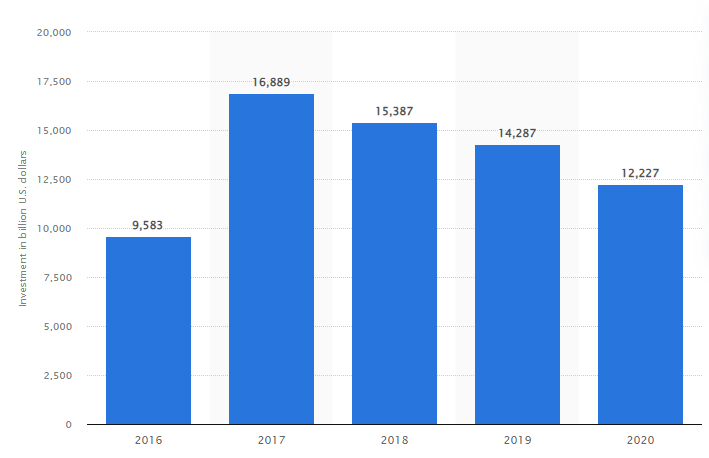
As we can see from the above statistics, the global market investment for AI in the automotive industry is gigantic, ranging from $9,583 billion in 2016, to $12,227 billion in 2020. The largest peak in investment was in 2017, amassing a figure of $16,889 billion. Due to several factors such asCovid-19, supply-chain disruptions, and high numbers of job loss, the EV industry has seen a plummet in global investment. But due to breakthroughs regarding the sophistication of the technology in the industry, it is predicted that global investment is going to rise once again. One of the most noteworthy advancements has been on behalf of Mercedes Benz, who are the world's first automaker to gain internationally valid regulatory approval in producing vehicles capable of Level 3 autonomous or "conditionally automated" driving.
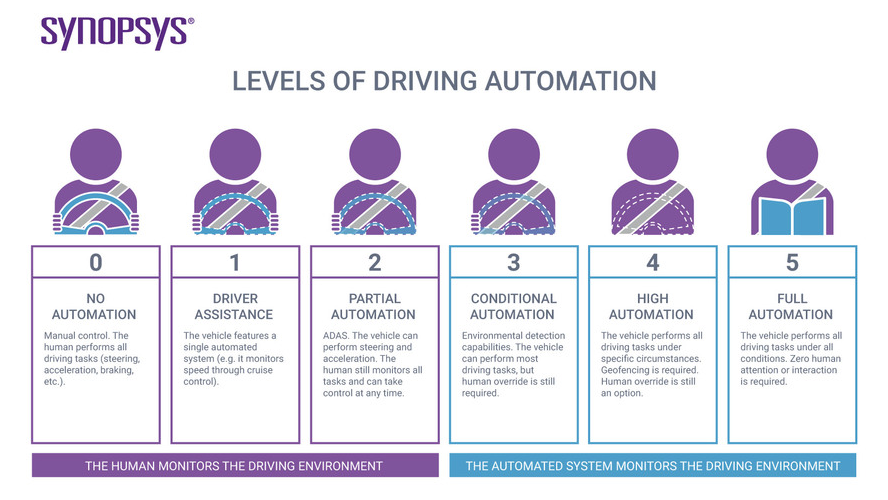
To give a little more context on the subject of automated driving, the Society of Automotive Engineers (SAE) defines 6 levels of driving automation ranging from0 (fully manual) to 5 (fully autonomous). These levels have been adopted by the U.S. Department of Transportation.
Another noteworthy mention is AI within the healthcare sector, which had a global investment of $5 billion in 2020, and is projected to grow to $45.2 billion by 2026, these significant investments show exponential growth which serves as a testimony to how relevant, applicable, and robust AI can be when applied correctly.
Many of the newly implemented technologies within the healthcare industry are still in their infancy and will need several additional years to mature and sophisticate, which means there will be challenges ahead, but overall, the general impression is extremely positive and promising.
In regard to the various technologies that are used within this industry, it is easy to assume that it’s mostly highly technical and relating purely to specific cutting-edge equipment that is specifically only aiding doctors and specialists, but the reality of the situation is that AI within the healthcare industry trickles down to patients in impactful ways.
Such as Natural Language Processing (NLP) powered chatbots that can engage in highly intelligent conversation to answer any means of questions, automated appointment scheduling, or obtaining access to medical records. All of these services previously required human intervention which inevitably slowed down the cycle of efficiency within the industry, but due to a sophisticated Human-AI collaboration, we’ve seen vast improvements in the healthcare sector, ranging from simple quality of life adjustments, to innovating cutting-edge lifesaving equipment.
Final thoughts:
It is quite clear that the global investments and various use cases serve as living proof that AI is here to stay, and is only advancing as time goes in. Our lives have been meaningfully impacted by the various technologies which have only been made available by implementation of AI and ML, which work in collaboration to provide solutions for a large number of currently existing problems, and even for those that we are yet to forecast, due to its prediction-based capabilities.
Human-AI collaboration is essential for the progression of humanity and provides us the key to our next step of technological advancements. The future is looking bright with an untold number of possibilities on the horizon.
Links and Further Reading:
Leggett, D., 2022. How is AI impacting the automotive industry?. [online] Just Auto. Available at: https://www.just-auto.com/features/how-is-ai-impacting-the-automotive-industry/.
Heath, N., 2021. What is AI? Here's everything you need to know about artificial intelligence | ZDNet. [online] ZDNet. Available at: https://www.zdnet.com/article/what-is-ai-heres-everything-you-need-to-know-about-artificial-intelligence/.
Statista. 2021. Investment in automotive AI | Statista.[online] Available at: https://www.statista.com/statistics/753747/global-investment-in-automotive-ai/.
Synopsys.com. 2022. The 6 Levels of Vehicle Autonomy Explained | Synopsys Automotive. [online] Available at: https://www.synopsys.com/automotive/autonomous-driving-levels.html.
Talby, D., 2021. Council Post: The Current State Of The Healthcare AI Revolution. [online] Forbes. Available at: https://www.forbes.com/sites/forbestechcouncil/2021/04/28/the-current-state-of-the-healthcare-ai-revolution/?sh=7b98c29a2980.
Marketsandmarkets.com. 2021. Artificial Intelligence in Healthcare Market Size Global forecast to 2027 | MarketsandMarkets™. [online]Available at: https://www.marketsandmarkets.com/Market-Reports/artificial-intelligence-healthcare-market-54679303.html?gclid=CjwKCAiAp4KCBhB6EiwAxRxbpFBz30E2wHi3KJCeyDhv3d1fyVZB606t-na38LvMFdeScz8dACIfeBoCK44QAvD_BwE.
Daugherty, P., 2018. Advancing Human-AI Collaboration |Accenture. [online] Accenture.com. Available at: https://www.accenture.com/ae-en/insights/future-workforce/missing-middle-skills-human-ai-collaboration.
.jpg)


You may get in touch via our
contact form or via the following:
+44 20 3650 2299
hola@qoakay.com


We work alongside our clients worldwide.
